

Another Open Source AI Debate
Plus: Anthropic partners with California, Discipulus closes $30M hard tech fund, Josh Kushner and Bob Iger eye NBA takeover

Happy Monday.
The current thing in tech and business is the Chinese company Zhipu AI’s open source LLM GLM 5.2, which some are saying has significantly narrowed the gap between open source and American frontier closed source models.
Today’s Lineup
National Design Studio Head of Engineering Edward Coristine at 11:45 AM
National Design Studio Engineer Tai Groot at 11:45 AM
Sygaldry Co-Founder & CEO Chad Rigetti at 12:00 PM
General Intuition Co-Founder & CEO Pim de Witte at 12:25 PM
Traysar Co-Founder & CEO Yadin Soffer at 12:30 PM
Engram Co-Founder & Head of Research Jack Morris at 12:35 PM
Sail Research Co-Founder Neil Movva at 12:40 PM
Discipulus Ventures Founder & General Partner Jakob Diepenbrock at 12:45 PM
Cadence Founder & CEO Chris Altchek at 1:00 PM
Run of Show

Another Open Source AI Debate — John Coogan
GLM-5.2 was officially released on June 13, 2026 and after some strong performance on benchmarks and positive reviews from developers, we are entering another round of debates around open source AI. What can the model actually do? Is this a threat to national security? What are the geopolitical ramifications here?
From the WSJ:
Security researchers said that a new AI model released this month by China’s Zhipu AI, also known as Z.ai, can match the latest U.S. models when it comes to finding security bugs, a development poised to reset the global tech race and pressure the White House in its overhaul of U.S. AI policy.
Unlike models from Anthropic or OpenAI, Zhipu’s GLM-5.2 is open-weight. That means it can be downloaded and run on hardware operated by anybody and can be modified and used without supervision. Open-weight models are ideal for users who want unfettered access to systems they control, but they are also ideal for hackers, who can run them in the shadows.
GLM-5.2 has ranked as one of the 10 most-used AI models, according to data from OpenRouter, a company that provides access to more than 400 AI models. In some benchmarking tests, according to the cybersecurity company Semgrep, GLM-5.2 bested Anthropic’s Claude Opus 4.8 model, which was released in May. When given further instructions, Opus 4.8 and GLM-5.2 can match Mythos in bug-finding ability, according to researchers.
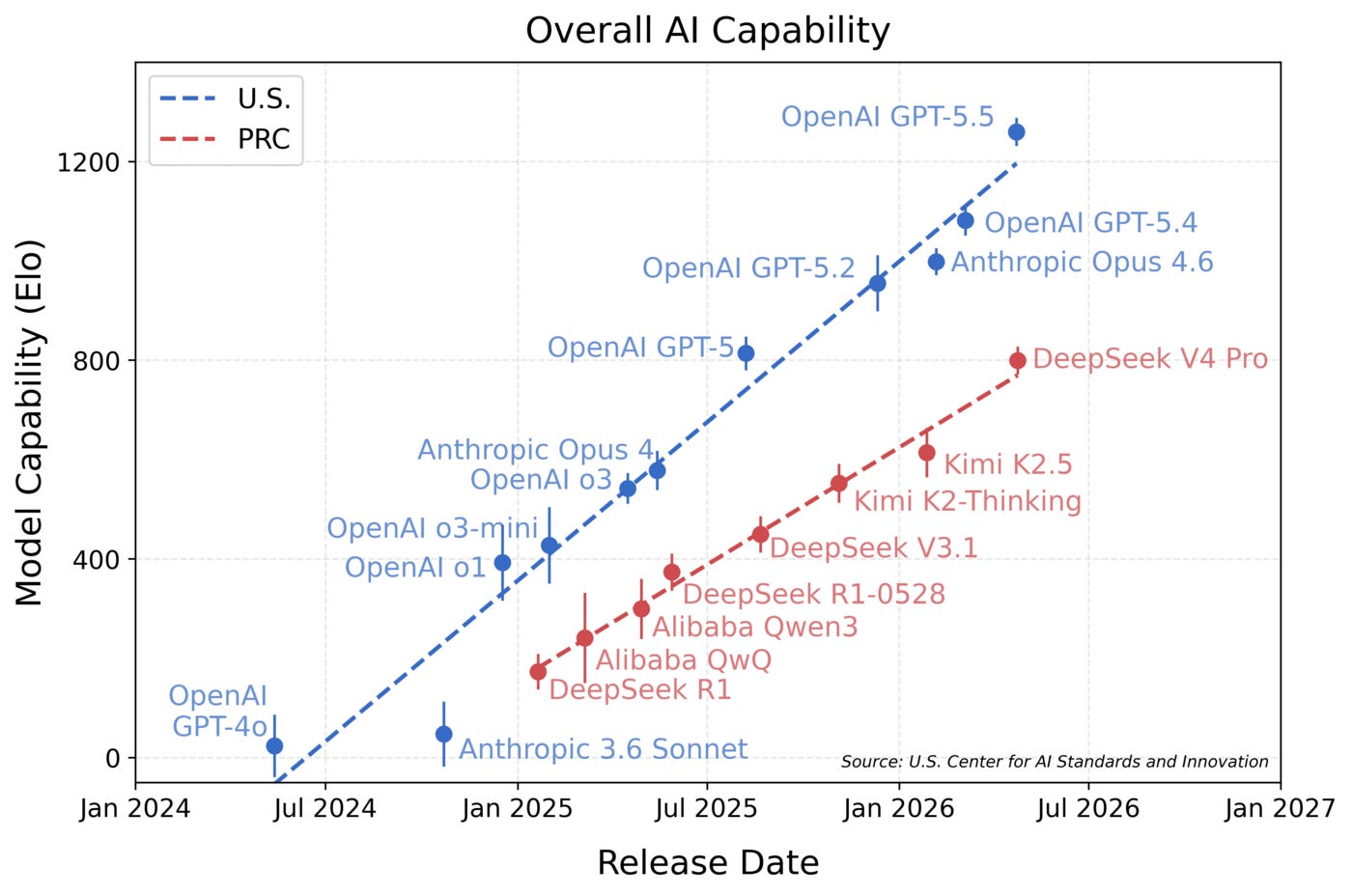
Prior to this launch, there was a narrative brewing that open-source AI was slowing down relative to the closed-source frontier (see the chart below).
Scaling laws around closed-sourced data flywheels and exponential capex intensivity predicted this, as John Luttig laid out in The future of foundation models is closed-source on May 21, 2024:
Open-source will have a home wherever smaller, less capable, and configurable models are needed – enterprise workloads, for example – but the bulk of the value creation and capture in AI will happen using frontier capabilities. The impulse to release open-source models makes sense as a free marketing strategy and a path to commoditize your complements. But open-source model providers will lose the capital expenditure war as open-source ROI continues to decline.
At the time, the open-source AI discussion was driven primarily by Mark Zuckerberg’s work at Meta on the Llama family of models. The idea was that Meta would benefit from attracting talent via the program and potentially commoditizing their complements, but then China sort of woke up with DeepSeek’s launch at the start of 2025 and the game theory became more complicated.
George Hotz has a take in AI will be massively deflationary as to why China benefits from investing in open-source AI more than American firms:
This explains why the Chinese are giving the (much more moderate resources to train) models away for free. They love to see deflationary economics in the US. Even if you regulatory capture the US government, nobody is getting a monopoly on AI, we don’t live in a unipolar world anymore.
So we’re back to discussion of the consequences of the impact of open-source models. A 2023 Congressional testimony from Dario Amodei is now recirculating:
But I’m very concerned about where things are going. If we talk about 2 to 3 years for the frontier models for the biorisks, and probably less than that for things like misinformation—we’re there now—I think the path that things are going, in terms of the scaling of open source models, I think it’s going down a very dangerous path. And, again, if the path continues, I think we could get to a very dangerous place.
The good news is that cybersecurity firms like Crowdstrike and Palo Alto Networks have been working with Mythos and GPT-5.5-Cyber for months now to harden systems from LLM-driven attacks. There is still a gap between the closed source and open-source models and that gap allows white hat hackers to implement fixes before black hat hackers have a chance to exploit the easy bugs. There will still be a bigger discussion here though in DC over the next few months as frontier models roll out. The gap doesn’t appear to be widening at the moment, so security stances must adjust.
Lastly, here’s a quick review from Tyler Cosgrove of GLM-5.2:
Very likely distilled from Claude models since it identifies as it often. If it is heavily distilled, it probably over performs on benchmarks because distilled models usually generalize poorly.
Definitely the leading open source model, especially for coding. Anecdotes I’ve seen mostly say that in creative tasks it is only a mild step up from GLM 5.1, meaning a large gap from the closed source models.
Very token hungry, so even though API price is much cheaper than closed source, if you price by task completion it can be more expensive than low thinking modes.
Not convinced that this should update beliefs too much. Besides the CAISI chart that showed the gap between American and Chinese models is growing, most other groups like Epoch AI show a pretty stable gap that would predict GLM 5.2-like performance.
I am not convinced that there is even a big market for this class of model, especially as frontier models get more token efficient. If you look at OpenRouter, the most used models are the smallest open source models, presumably being used for specific tasks that need to be repeated over and over.
Here’s a side by side SVG test of GLM 5.2 vs GPT-5.5. Can you tell which is which?

Clip Spotlight: The Air Conditioning Company of Europe
On Friday Jordi pointed out that there’s a huge opportunity to start The Air Conditioning Company of Europe right now.
We're normally against this naming structure because of how overused it's become, but we like it here.
Headlines
WSJ: China Has Matched Anthropic in Cybersecurity, Resetting AI Race
The Information: Internal Docs Show Meta Putting Limits on Claude and Codex, Fearing Distillation
Politico: Newsom, Anthropic ink deal to expand government use
FT: Google caps Meta’s Gemini use as AI demand strains capacity
WSJ: Chip Makers Are Profiting Off AI at the Expense of Just About Everyone Else
The Information: Amazon Could Pay More for Anthropic Technology Under New Deal
Axios: Exclusive: Discipulus Ventures closes $30M hard-tech fund
Fortune: The 33-year-old executive Satya Nadella is trusting to fix Microsoft’s Copilot AI assistant
Barron’s: Micron Is Breaking the Shackles of History. Why the Stock Could Still Double From Here.
Travis Kalanick reveals his morning commute to new Austin office is via jetski
Forbes: 5 More AI Predictions For The Year 2030
FT: To cool or not to cool: French politicians draw battle lines over aircon
Telegraph: France blames US for deadly heatwave
Bloomberg: Bob Iger, Joshua Kushner Explore Bid for NBA Expansion Team
NY Post: AOC says ‘we need to break up these companies’ after Apple raises prices by $200
WSJ: The AI Startup Challenging Tesla and Waymo in the Race to Automate Driving
WSJ: Rocket Lab Buys Satellite Operator Iridium in Bid to Challenge SpaceX
8090 Labs raises $135M in Series A funding led by Salesforce Ventures
WSJ: Comcast Plans Company Split as Competition Escalates
Business Insider: How Terry Semel Fumbled Yahoo’s Facebook Deal
FT: Robots, not chatbots, will realise AI’s potential
WSJ: The Father Who Bankrolled a High-School Football Team for His Son
WSJ: European Soccer Fans Marvel at the Splendor of America’s Suburbs
Posts of the Day


Special thanks to our sponsors: Ramp, Shopify, CrowdStrike, MongoDB, NYSE, Codex, Public, Console, Railway, Figma, and Cisco.