

IBM’s AI Rollercoaster
Plus: Demis posts framework for AI standards body, NY governor signs data center moratorium EO, Terrafirma raises $100M Series A

Happy Tuesday.
The current thing in tech and business is Anthropic’s new ad, which features a house on fire and rows of gravestones.
Today’s Lineup
Puck Founding Partner & Senior Correspondent Dylan Byers at 11:30 AM
Terrafirma Co-Founder & CEO Noah Schochet at 12:00 PM
Greylock General Partner Saam Motamedi at 12:10 PM
Reflection Co-Founder & President Ioannis Antonoglou at 12:25 PM
Chai Discovery Co-Founder Jack Dent at 12:30 PM
State Affairs Co-Founders Evan Burns and Jamie Seltzer at 12:40 PM
Cipher Digital CEO Tyler Page at 12:45 PM
Run of Show
IBM’s AI Rollercoaster, by John Coogan

IBM has done well in the AI era. The stock has basically doubled since the introduction of ChatGPT. But the last few months have been a brutal rollercoaster and just today the stock dropped 25% in morning trading. It’s the biggest stock drop in the history of the 115-year-old company. The high-level reason is that IBM is not well positioned “in the token path” to use Brad Gerstner / Gavin Baker parlance. AI spending is currently flowing into GPUs, memory, networking, hyperscale cloud capacity, and frontier model inference. IBM is not a major winner in these categories.
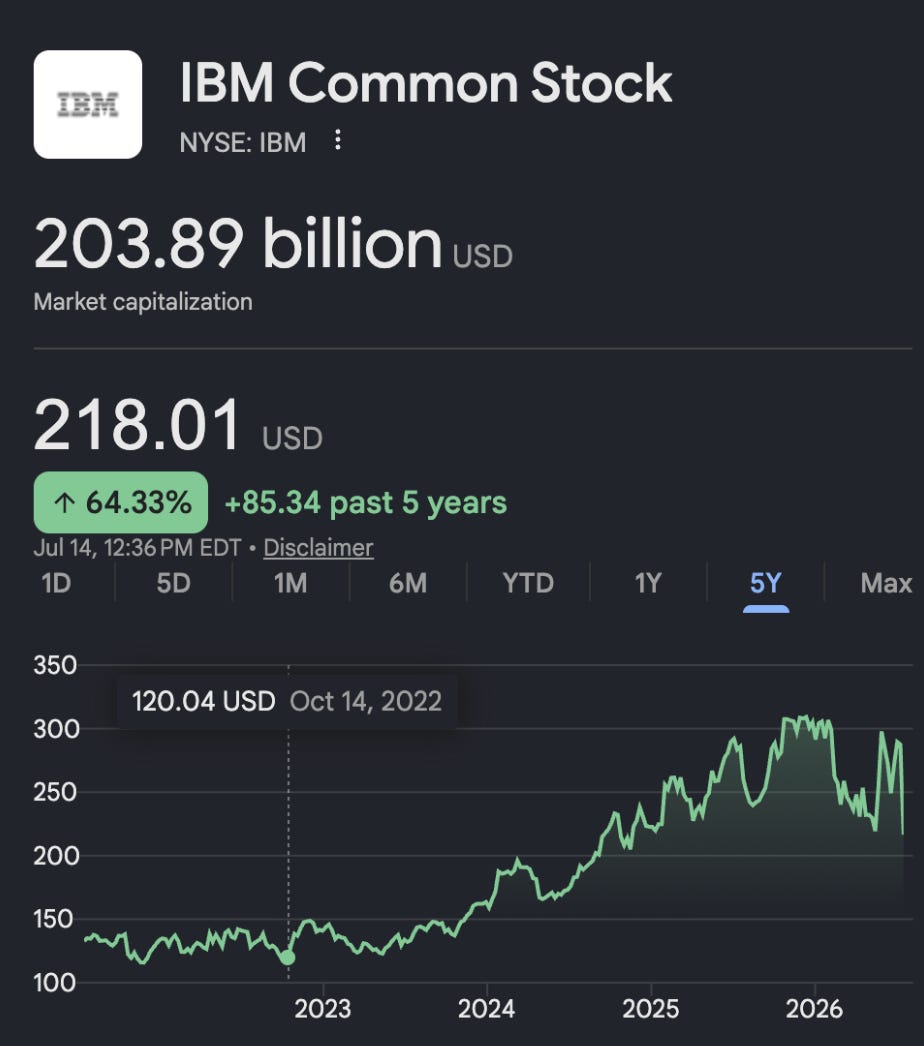
Let’s refresh on IBM. Great name. International Business Machines. They made punch-card systems, clocks, tabulating machines, basically a bunch of different ways to process information mechanically. The foundational insight was that businesses would continually pay to automate record-keeping and at a high level they have sort of been working on that continuously throughout their history.
In 1964, IBM announced the System/360, which was a compatible family of devices that customers could upgrade piecemeal without redesigning their entire workflow. This preposition turned IBM into the dominant supplier of corporate computing. Banks, insurers, airlines, manufacturers and governments built their central systems around IBM hardware and software. It was the “mainframe” era.
IBM became dominant in mainframes through a combination of high reliability, long customer relationships, expensive switching costs, proprietary software tied to their hardware, and a mix of support and consulting work that looked sort of like a precursor to forward deployed engineering if you squint.
The IBM PC, launched in 1981, legitimized the personal computer market and set up two new companies, Intel and Microsoft, to capture immense value during the next computing boom. (For relative scale, IBM was doing $30B in revenue, Intel was doing less than $1B, and Microsoft was doing only $17M). The market eventually fractured and proposals to break IBM into separate companies started to pop up. Lou Gerstner, who became CEO in 1993, rejected this idea though, and argued “We do not necessarily need to manufacture every piece of technology. We need to be the company that makes all of it work together.” His strategy ultimately produced IBM Global Services, large outsourcing contracts and a vast consulting organization.
Services businesses have limitations though: lower margins, higher headcount, slower organic growth, price competition, etc. In 2019 IBM acquired Red Hat for $34B and spun off its traditional managed-infrastructure outsourcing business as Kyndryl in 2021.
So today, IBM is 44% software (like Red Hat), which sits at 80+% gross margin, 31% consulting which is under 30% gross margin and 23% infrastructure which is just under 60% gross margin. For the past 3 years, the stock has been doing really well, up 77% before dividends. The Red Hat acquisition started paying off, and the z17 mainframe cycle was solid.
But IBM just called out a shift away from mainframe spending with customers shifting capital spending toward the physical AI buildout. Demand for AI and associated hardware is strong, but IBM is losing share of their customer’s technology budget. IBM does still have a strong asset for the AI-era in Red Hat OpenShift, which is their enterprise Kubernetes platform, but there are so many other companies offering AI capabilities up and down the stack.
Clip Spotlight: Alexis Ohanian says collectibles are his generation's contemporary art
"Having an '86 Fleer Jordan rookie card in mint condition on my desk is a more satisfying flex for me than having, like, a Warhol."
"I'm a big fan of collectible video games, match-worn athletic apparel, etc. All these things are culture assets for us."
"I think this is our contemporary art. Especially for a generation of us who grew up collecting and idolizing [these athletes]."
Headlines
Demis Hassabis: A Framework for Frontier AI and the Dawning of a New Age
FT: DeepMind chief Demis Hassabis calls for US-led body to test ‘frontier’ AI models
Axios: N.Y. Gov. Kathy Hochul signs data center moratorium executive order
WSJ: Can a Dozen Blue States Block the Paramount-Warner Merger?
The Information: Exclusive: Behind Google’s TPU Ground War to Lure Nvidia’s Most Loyal Customers
Stratechery: The OpenAI Super App, ChatGPT = Codex, Whither Chat
Terrafirma raises $100M Series A led by Kleiner Perkins
WSJ: IBM Suffers Biggest Share Drop in Its History
WSJ: Frontier Airlines, a Wi-Fi Holdout, Is Partnering With SpaceX’s Starlink
WSJ: Meta Is Flooding the Market With Smartglasses. Privacy Advocates Are Up in Arms.
A Rabbit’s Foot: The Last Picture Show: a conversation with George Lucas
WSJ: Vail CEO Says Comeback Plan for Ski Resorts Needs to Be Beyond Epic
Jesse Zhang: Why the “Math Mafia” is doing well
WSJ: The Superrich Aren’t Just Buying Mansions—They Want the Entire Block
Posts of the Day


Special thanks to our sponsors: Ramp, Shopify, CrowdStrike, MongoDB, NYSE, Codex, Public, Console, Railway, Figma, and Cisco.