

Meta Sells Compute?
Plus: Conception achieves fertility breakthrough, Anthropic to redeploy tweaked Fable 5, xAI rolls out data center dividend for Memphis residents around Colossus

Happy Wednesday.
The current thing in tech and business is the news that Meta may be planning to sell its excess compute, leading to a sharp AI selloff in the public markets.
Today’s Lineup
Zynga Chairman & Founder Mark Pincus at 11:30 AM
Integral Co-Founder & CEO Shubh Sinha at 12:00 PM
Lime CEO Wayne Ting at 12:15 PM
Assort Health Co-Founders & Co-CEOs Jeff Liu & Jon Wang at 12:20 PM
Dominion Dynamics Founder & CEO Eliot Pence at 12:30 PM
Bending Spoons Co-Founder & CEO Luca Ferrari at 12:40 PM
Union Square Ventures GP Nick Grossman at 1:00 PM
Amble Co-Founder & Chief Design Officer Julian Hoenig at 1:20 PM
Run of Show

Meta Sells Compute?
From Bloomberg:
Meta Platforms is developing plans for a cloud infrastructure business to sell access to AI computing power and models, competing with industry leaders like AWS and GCP. The company is considering selling access to various AI models hosted on its existing AI infrastructure, as well as “raw” computing capacity, as part of its Meta Compute initiative. Meta’s plans to generate revenue from excess computing power could help return its investment in AI infrastructure, which includes hundreds of billions of dollars spent on data centers and expensive chips.
Neoclouds are selling off on the news. Oddly enough, Meta has several large contracts with neoclouds as well. The company is definitely GPU rich, but has seemed to struggle with launching sticky AI powered applications.
It’s odd because they spent so much money building a team of researchers, have all the data in the world, and should be able to get near the frontier pretty quickly. Benchmarks for their latest Muse Spark model seem decent, certainly enough to roll out to the billions of Meta users if they find a cool use-case. I’ve been disappointed by the lack of AI in meta apps (I realize this is an odd take, since the general vibe on Instagram is very anti-AI), but I don’t mean directly in the content even. Meta has granular data about every reel I post, some do better than others, yet when I ask Meta AI in the IG app what I should do more of in order to grow my account, I get a generic LLM response that cites a Buffer blog post with very stale strategies like adding keywords to my profile and replying to every comment. That’s not what I want.
Adam Mosseri has done a great job going direct and explaining the various nuances of the Instagram algorithm and any new features as they roll out, but his videos aren’t exactly personalized. I want an agent that can actually process all the data about my account and act as a little social media co-pilot. Maybe I’m in the minority here, but I feel like this is just one of the many ways that Meta could actually deliver AI to users in a way that feels native to the experience.
And then there’s agentic shopping. AI (even clunky, lagging edge AI) should be able to remove at least one click from the shopping experience, but I haven’t seen them even try. Maybe there are more complex business considerations here, or maybe they are still wounded from previous attempts to own more of the ecommerce funnel, but it does seem like the future, so I don’t understand why they don’t at least experiment here. Either way, this does feel like a wind down of the superintelligence ambitions that Zuck laid out last year. If it follows the path of the Metaverse, perhaps we’ll get some AI equivalent of the Meta Glasses in a few years. — John
Conception’s Fertility Breakthrough
IVG has the potential to redefine reproduction worldwide. From a simple blood draw, one could make as many healthy eggs as a family needs.
Yesterday morning, Matt Krisiloff, CEO of the fertility startup Conception, announced what appears to be a major breakthrough: the company successfully generated what it says are the first early human egg cells from stem cells created from a simple blood draw.
Conception’s explanation of the process is fascinating to read, and the company goes into detail about it here. The steps required to generate the early egg cells are not at all intuitive, at least to someone without any technical knowledge of the subject. Basically, Conception first converted blood cells into stem cells, then guided those cells toward becoming the types of cells found in a developing ovary, some of which eventually become early egg cells. Conception added “ovarian helper cells” to the mix, and this cluster of cells formed “mini-ovaries” that mimic a true human ovary.
Another fascinating aspect of Conception’s process is that other structures that normally form in human ovaries also appeared in their synthetic “mini-ovaries.” For example, the company observed ovarian structures that help separate and organize growing egg cells developing within the mini-ovaries. It’s a sign that the system is developing in a way that resembles normal human ovarian development.
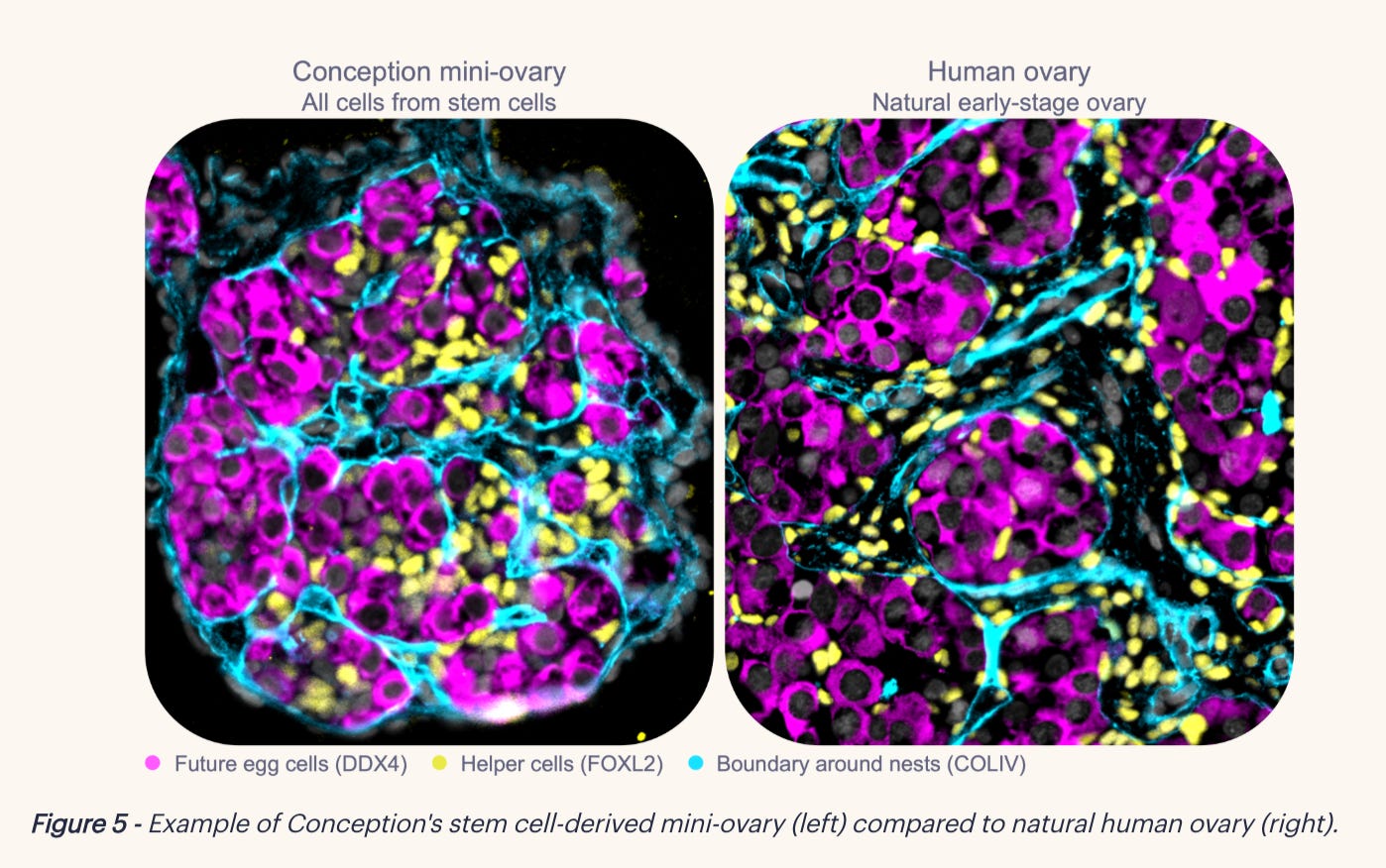
In 2016, Japanese researchers showed that this process could work in mice, producing offspring that grew into healthy adults with normal lifespans and reproduced naturally. Conception’s breakthrough did not produce mature egg cells, so we’re not at the point where you can just get a blood draw and have mature eggs come out the other end. But this news brings that future closer. — Brandon
Clip Spotlight: Recent FDA recommendations are bad news for peptide compounders
The FDA’s recent recommendations on peptides are a *significant* setback for new and existing companies being built around the expectation that they will be able to sell compounded peptides.
That’s because the 503A Bulks List is basically a pathway that lets compounding pharmacies use certain bulk drug substances to compound drugs for patient-specific prescriptions. The FDA is recommending against adding seven popular peptides to the list.
Unless RFK goes against the FDA staff recommendation, these companies’ path to legally compounding and selling peptides becomes very difficult.
Headlines
Bloomberg: Meta Is Planning a Cloud Business to Sell AI Computing Power
CNBC: Anthropic launches AI drug discovery program, joining tech giants in betting on healthcare
Anthropic to redeploy Fable 5 today after government hold up
NPR: Meta considered buying Kalshi before developing its own prediction market app
Citrini Research publishes primer on humanoid robots
ZeroHedge: xAI Rolls Out Data Center Dividend For Residents Around Memphis Colossus
WSJ: Ashton Kutcher Exits From Sound Ventures to Set Up New Venture Firm
Apple teases Neuromancer adaptation
Posts of the Day


Special thanks to our sponsors: Ramp, Shopify, CrowdStrike, MongoDB, NYSE, Codex, Public, Console, Railway, Figma, and Cisco.