

The AI Cold War
Plus: Netflix shares the company used GenAI across 300 movies and shows, The Odyssey opens to $125M, and Etched is in talks to raise funding at a $20B valuation.


Happy Monday.
The current thing in tech and business is reactions to Kimi K3.
Today’s Lineup
Author Tyler Cowen at 12:00 PM
IM8 Co-Founder Danny Yeung at 12:35 PM
a16z GP Connor Love at 12:40 PM
Natural Co-Founder & CEO Kahlil Lalji at 12:50 PM
Kalshi Co-Founder & CEO Tarek Mansour at 1:00 PM
Sunday Robotics Co-Founder & CEO Tony Zhao at 1:20 PM
Run of Show
The AI Cold War, by John Coogan

Moonshot introduced Kimi K3 last Thursday and the timeline chewed through the story over the weekend. As always, it’s over, we’re back. The headlines are impressive, but not wildly surprising based on current trendlines in model progress. It does seem to invalidate the thesis that open source would start falling behind though. In the most above board scenario, the Moonshot team is just a bunch of highly talented AI researchers who marshalled enough compute to release a great model. Open sourcing Kimi is a great way to grab attention, attract talent, and drive demand for hosted API services that are more turnkey. The more skeptical take runs along the lines of: the compute was smuggled to China against chip controls, the data was exfiltrated from frontier lab APIs routed through wrapper companies, the open source strategy is a deliberate attempt to destroy American companies, and there might even be spies inside companies stealing IP directly. The reality is probably some mix of both.
There are bigger questions about AI safety in a world of powerful open-source AI. I haven’t seen a ton of takes from that crowd but it doesn’t feel like they’d be happy about it. From a cybersecurity perspective, there’s another more powerful tool in the attacker’s tool chest, but fortunately defenders have had roughly 6 months of frontier exclusivity to prepare. There’s no debating that open source AI is punk rock, it feels like Napster. There’s something deeply satisfying about the idea of a solar-powered server rack serving you up unstoppable intelligence. A country of geniuses in a datacenter (owned by a company) sounds cool, but a single genius in my house who is entirely on my team sounds way cooler.
The US Government is going back and forth on how to handle this situation, and I imagine there will be a few developments this week (Kimi K3 weights drop next Monday). I see this mostly as a small example of the bigger competition with China. It’s the same thing they’ve done with cars, drones, and solar panels, to some extent. Some government subsidies, genuinely lower costs, alleged IP theft, occasionally questionable stuff, but also sometimes just straight outcompeting and having a powerful ecosystem of industrial output.
This is annoying for American companies. No one wants to be GoPro. Everyone in the car industry has a clear view into where this goes too. In the short term, this can be good for American consumers, cheap TVs, cheap toys, cheap AI, etc, but long term, you risk sort of losing an industry, and then being worried about all the geopolitical risks (they could cut you off in a conflict, they could spy, etc etc)
Either way, the Kimi news does not have me blackpilling in the slightest. I’m excited about expensive frontier intelligence and I’m excited about near-frontier intelligence that’s too cheap to meter. I think there will be value created up and down the stack as these systems work their way through the economy. In order to understand all the different knock-on effects, I recommend working through the following reactions:
Timeline Reactions to Kimi:
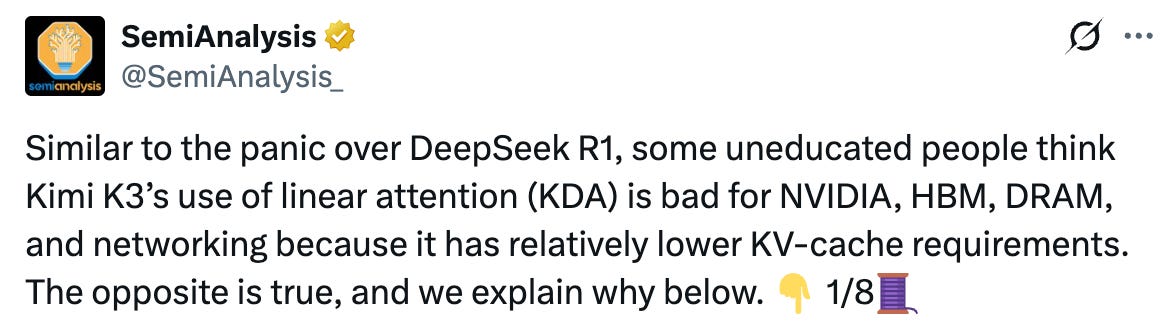
SemiAnalysis - Kimi K3’s architecture actually strengthens demand for AI infrastructure because it requires massive multi-GPU clusters, high bandwidth networking, and significant memory.
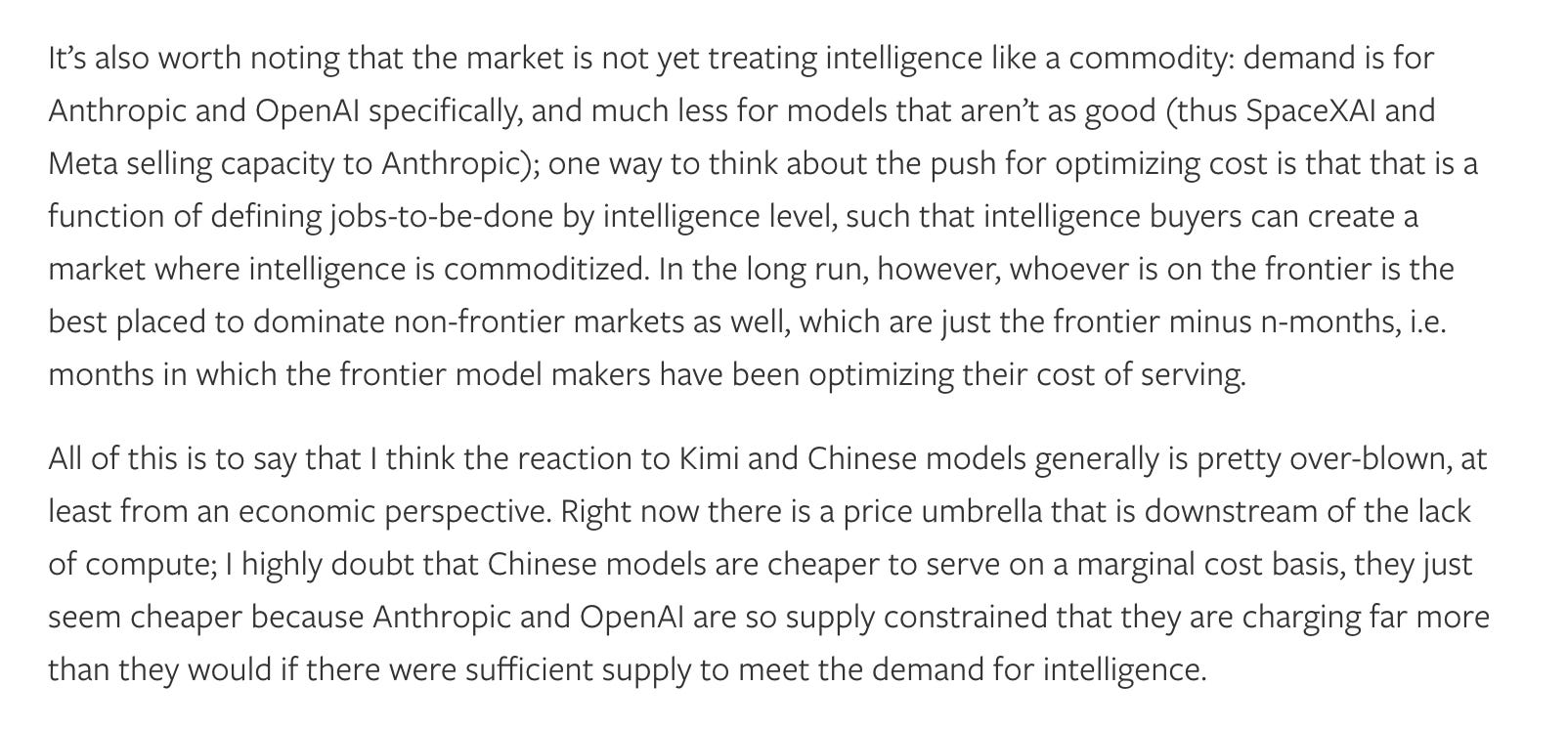
Stratechery - Ben Thompson believes concerns over Kimi are overstated because demand still favors frontier labs like OpenAI and Anthropic, whose pricing is driven more by compute shortages than by any lasting cost advantage from Chinese competitors.
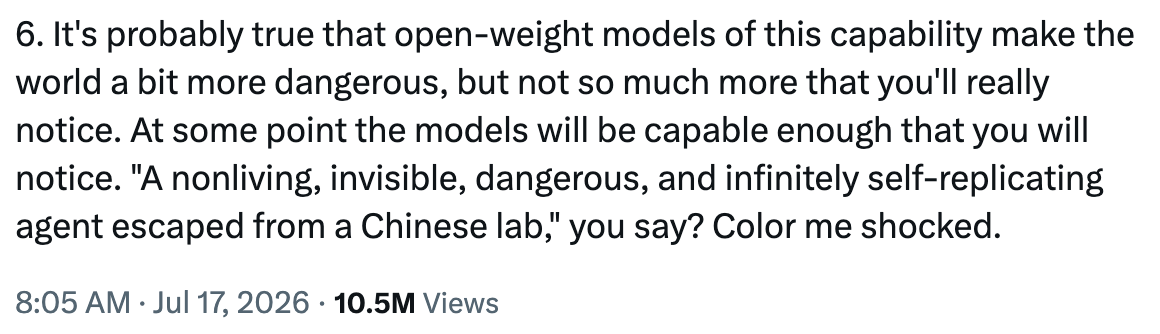
Dean Ball: He lays out that Kimi proves China can produce frontier-class open-weight AI models, but warns they could weaken commercial AI incentives, shift AI toward public infrastructure, increase geopolitical tensions, and eventually create significant security risks.
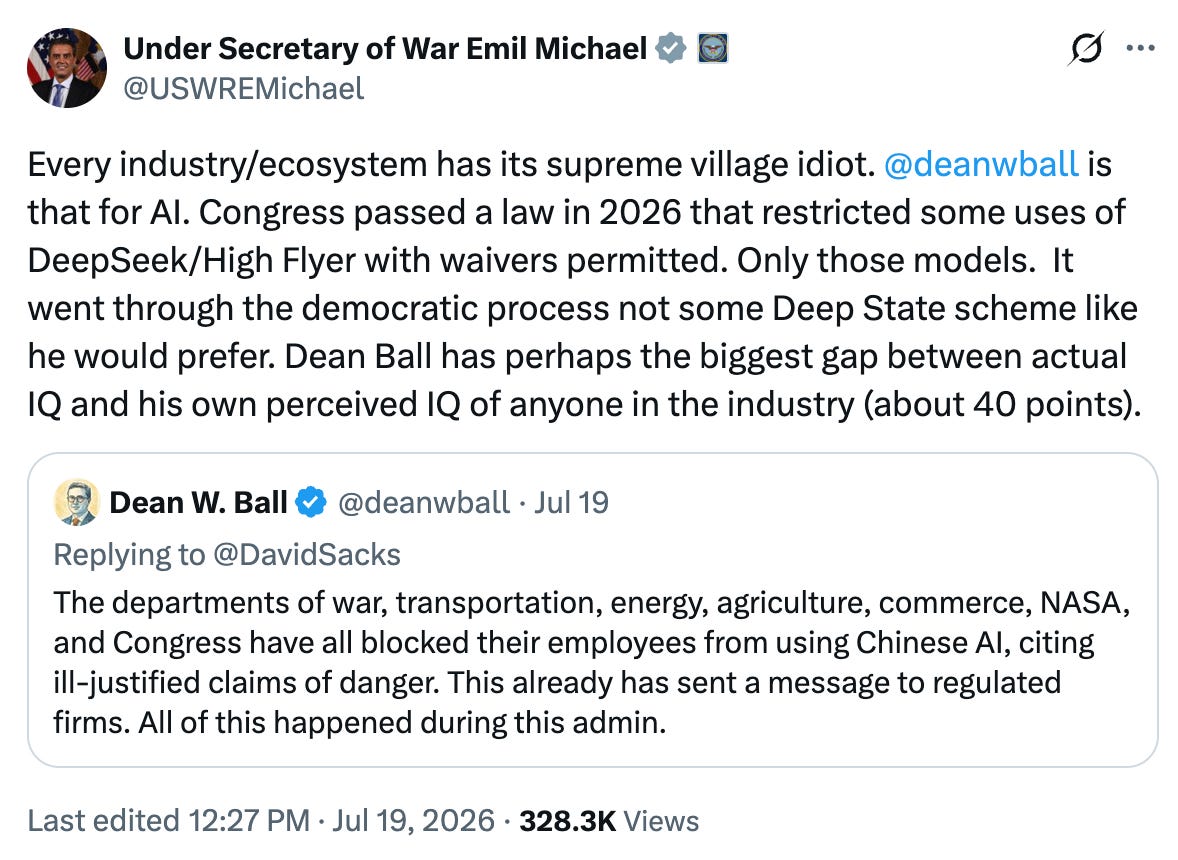
Under Secretary of War Emil Michael’s response to Dean Ball:
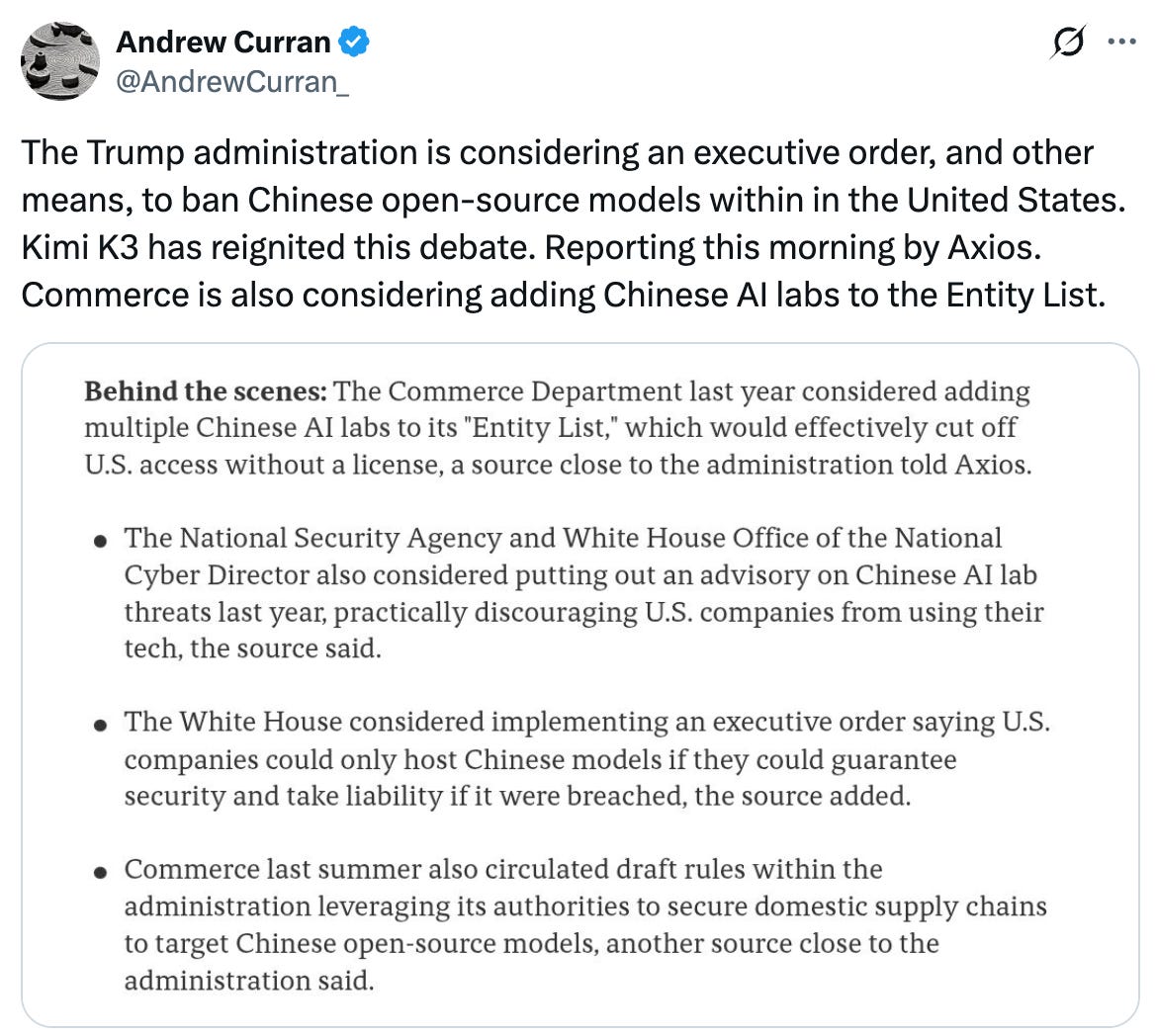
Andrew Curran: According to Axios, the Trump administration is exploring the idea of banning Chinese AI models.
Clip Spotlight: Ramp CEO says most B2B SaaS is awful for one reason:
Every user wants something different from the same product.
But he’s bullish that generative interfaces can tailor tools to the unique needs of each user, from the AP clerk to the accountant to the CFO.
Headlines
WSJ: Could China’s Moonshot AI Create a ‘DeepSeek 2.0’ Moment in Markets?
NYT: China’s Latest A.I. Breakthrough Threatens America’s Lead
Bloomberg: Moonshot’s Kimi K3 May Be More About Memory Than Compute
Stratechery: Who’s Afraid of Chinese Models?
Axios: The secret Trump administration battle to fight Chinese AI
SemiAnalysis on how Kimi K3 affects NVIDIA and networking
NYT: Meta in Talks to Lease Computing Power to Anthropic in Potential $10 Billion Deal
Bloomberg: Why Apple’s Lawsuit Against OpenAI Over Devices Spares Jony Ive
WSJ: AI Chip Startup Etched Is in Talks for $20 Billion Valuation
X user ‘levent’ declares the Jacobian Conjecture false
Bloomberg: Christopher Nolan’s Epic ‘The Odyssey’ Opens to $125 Million
The Information: Startup OpenRouter Fields Multibillion-Dollar Takeover Interest
Marginal Revolution: Trial Lawyers Lobby Against Autonomous Vehicles
WSJ: Five Cups of Coffee a Day Is Fine for Most Adults, Heart Association Says
Variety: About 300 Netflix Titles Used Generative AI This Year, Company Reveals
Vanity Fair: The Glamorous Inner Workings of the Polo Lounge, Hollywood’s Reigning Power-Lunch Spot
Clifford Sosin: Maybe Intelligence Ain’t All That
Posts of the Day


Special thanks to our sponsors: Ramp, Shopify, CrowdStrike, MongoDB, NYSE, Codex, Public, Console, Railway, Figma, and Cisco.